Cole Page
Credit Analyst · cole.page.2027@anderson.ucla.edu · colehpage.com
Vestis: BUY at $14.09 Before the FY27 Outlook
BUY at $14.09 with a $20.50 target. The Street has FY27 EBITDA at the Q3 run-rate and gives no credit for a Q4 the company has already guided to, and the free cash flow is going to debt.
The Call
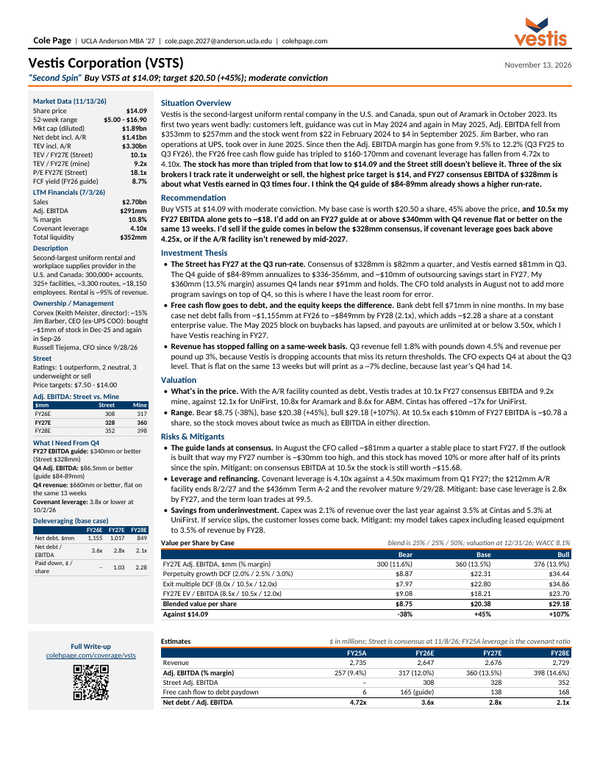
Buy VSTS at $14.09 with moderate conviction. My base case is worth $20.50 a share, 45% above the price, and 10.5x my FY27 EBITDA alone gets to ~$18. My bear case is $8.75, so I'm risking about 38% to make about 45%. I'd add on an FY27 guide at or above $340mm with Q4 revenue flat or better on the same 13 weeks. I'd sell if the guide comes in below the $328mm consensus, if covenant leverage goes back above 4.25x, or if the A/R facility isn't renewed by mid-2027.
| 11/13/26 | VSTS |
|---|---|
| Share price | $14.09 |
| 52-week range | $5.00 - $16.90 |
| Market cap (diluted) | $1.89bn |
| Net debt incl. A/R facility | $1.41bn |
| TEV incl. A/R facility | $3.30bn |
| TEV / FY27E EBITDA, Street / mine | 10.1x / 9.2x |
| P/E FY27E (Street) | 18.1x |
| FCF yield (FY26 guide) | 8.7% |
| Bear / base / bull | $8.75 / $20.38 / $29.18 |
I keep conviction at moderate because the CFO's August comments point closer to consensus than to my number, and the December outlook decides most of the next six months. I also wrote up the Term Loan B-1, which I'd hold at 99.5 and add to at 97.5 (the credit memo); the loan can't pay more than par, so a better FY27 only shows up in the equity.
Situation
Vestis is the second-largest uniform rental company in the U.S. and Canada, spun out of Aramark in October 2023. Its first two years went badly: customers left, guidance was cut in May 2024 and again in May 2025, Adj. EBITDA fell from $353mm to $257mm and the stock went from $22 in February 2024 to $4 in September 2025. Jim Barber, who ran operations at UPS, took over in June 2025. Since then the Adj. EBITDA margin has gone from 9.5% to 12.2% (Q3 FY25 to Q3 FY26), the FY26 free cash flow guide has tripled to $160-170mm and covenant leverage has fallen from 4.72x to 4.10x. The stock has more than tripled from that low to $14.09 and the Street still doesn't believe it. Three of the six brokers I track rate it underweight or sell, the highest price target is $14, and FY27 consensus EBITDA of $328mm is about what Vestis earned in Q3 times four. I think the Q4 guide of $84-89mm already shows a higher run-rate.
Vestis rents and launders uniforms and supplies mats, towels, restroom and first-aid products to more than 300,000 accounts from 325+ facilities and ~3,300 routes. A driver shows up every week, swaps dirty for clean and restocks the supply cabinet, and the customer pays under a multi-year contract. Rental is ~95% of revenue; in the first nine months of FY26 workplace supplies were 63% and uniforms 37%. The U.S. was 91% of FY25 revenue and Canada 9%, and the ten largest customers are under 10%. Cintas leads the industry, Vestis is second and UniFirst third.
Aramark kept the cash. It spun Vestis off in October 2023 with $1.5bn of term loans and kept most of the proceeds. One of the securities suits alleges Aramark underinvested in the plants and in service before it let the business go.
Customers left faster than new ones came in. Revenue fell from $2,805.8mm in FY24 to $2,734.8mm in FY25 even with a 53rd week worth $51.6mm, and Adj. EBITDA fell from $352.9mm (12.6%) to $257.4mm (9.4%). The stock fell 49% over two sessions on the May 2024 guidance cut and 39% on the May 2025 one. The CEO left in March 2025, the dividend was suspended and the banks reset the covenant.
| Quarter | Revenue | Year over year | Adj. EBITDA | Margin |
|---|---|---|---|---|
| Q1 FY25 | 683.8 | -4.8% | 81.1 | 11.9% |
| Q2 FY25 | 665.2 | -5.7% | 47.6 | 7.2% |
| Q3 FY25 | 673.8 | -3.5% | 64.0 | 9.5% |
| Q4 FY25 (14 weeks) | 712.0 | +4.0% (-3.5% same weeks) | 64.7 | 9.1% |
| Q1 FY26 | 663.4 | -3.0% | 70.4 | 10.6% |
| Q2 FY26 | 659.4 | -0.9% | 74.5 | 11.3% |
| Q3 FY26 | 661.7 | -1.8% | 80.9 | 12.2% |
| Q4 FY26E (guide is $84-89mm) | 662.0 | +0.2% same weeks | 91.2 | 13.8% |
$ in millions; Q4 FY26E is my estimate.
Management. Barber spent more than 35 years at UPS and finished as chief operating officer. He joined on 6/2/25. Chairman Phillip Holloman is a former president and COO of Cintas. Russell Tiejema became CFO on 9/28/26, and Vestis reaffirmed its FY26 outlook that day.
Costs. The plan launched in December 2025 targets at least $75mm of annual savings. About $50mm lands in FY26, roughly $30mm of it through Q3 and ~$20mm in Q4, and outsourcing corporate support adds ~$10mm a year from FY27.
Price over volume. Vestis repriced its low-margin accounts and let the ones that wouldn't pay leave. Barber said in August that it kept about 75% of that volume, and what left was paying about $0.55 a pound against $1.42 for the business as a whole. In Q3 pounds fell 4.5%, revenue per pound rose $0.04 to $1.42 and cost per pound was flat at $1.24, so the spread went from $0.14 to $0.18.
Cash. The FY26 free cash flow guide started at $50-60mm in December, went to $120-150mm in May and to $160-170mm in August. Nine-month free cash flow was $120.8mm. Part of that is a working capital release that won't repeat, which is why my FY27 free cash flow after interest is $138mm.
Investment Thesis
1. The FY27 number
Vestis earned $80.9mm of Adj. EBITDA in Q3 and guided Q4 to $84-89mm. FY27 consensus is $327.6mm, or $81.9mm a quarter. So the Street has FY27 at roughly the Q3 level and gives no credit for the Q4 step-up or for the outsourcing savings.
Management has said two things about FY27. In May the interim CFO said it starts from the Q4 exit rate. In August he said Vestis was at a run-rate of about $81mm going into Q4, called that a stable place to start building FY27, and told an analyst not to add another $25mm of savings on top, because Q4 already carries ~$20mm of the program ($75-80mm annualized). I read that as the program being fully in the Q4 number. I don't know yet whether the FY27 outlook will look more like Q3 or like Q4.
My base case assumes it looks like Q4. I have Q4 at $91mm, a little above the guide, and FY27 at $360mm, which is that run-rate held for a year with the outsourcing savings covering wage inflation. I'm above the guide for Q4 because Vestis raised its EBITDA or cash flow outlook in each of the last two quarters and the Q3 margin was already 12.2% with less of the program in it. If I'm wrong and FY27 is guided near $330mm, my FY27 number comes down ~8% and the equity is worth closer to $16 than $18 on the near-term multiple.
| Adj. EBITDA, $mm | Street | Mine |
|---|---|---|
| FY26E | 308 | 317 |
| FY27E | 328 | 360 |
| FY28E | 352 | 398 |
2. Debt paydown
None of this year's free cash flow has gone to shareholders. Bank debt fell from $1,168.5mm to $1,097.5mm in nine months and covenant leverage from 4.72x to 4.10x. In my base case net debt falls another ~$306mm by FY28. At a constant enterprise value that is ~$2.28 a share moving from lenders to shareholders, 16% of today's price, before any change in the multiple.
| Base case | LTM 7/26 | FY26E | FY27E | FY28E |
|---|---|---|---|---|
| Adj. EBITDA | 291 | 317 | 360 | 398 |
| Free cash flow to debt paydown | 165 (guide) | 138 | 168 | |
| Net debt (year end) | 1,200 | 1,155 | 1,017 | 849 |
| Net debt / Adj. EBITDA | 4.10x (covenant) | 3.6x | 2.8x | 2.1x |
| Cumulative paydown per share | $1.03 | $2.28 |
$ in millions; net debt includes finance leases and excludes the A/R facility.
The credit agreement also no longer blocks buybacks, which I don't think is widely noticed. The May 2025 amendment barred dividends and repurchases until leverage was at or below 4.50x for two straight quarters. That happened in Q2 and Q3 (4.47x and 4.10x). Vestis can now return ~$95mm under its general basket and unlimited amounts at or below 3.50x. Management hasn't said it will, and I'd rather it kept paying down debt until the A/R facility and the Term A-2 are refinanced. But Corvex owns ~15% and Keith Meister sits on the board, so I'd expect the conversation to start in FY27.
3. Revenue
Revenue is the weakest part of the story and the easiest to misread in December. Q3 revenue fell 1.8% because pounds fell 4.5% while revenue per pound rose 3%. Barber said in August that Vestis plans to grow in FY27 and that churn has to keep coming down. The CFO expects Q4 at about the Q3 level, ~$662mm. Against last year's Q4 on the same 13 weeks ($660.4mm) that is flat. Against the $712.0mm Vestis reported for 14 weeks it is down ~7%, and that is the number the headlines will carry. My base case grows revenue 1.1% in FY27 and 2-3% a year after that. If revenue keeps shrinking, the savings get spread over a smaller base and my bear case applies.
Industry and Competition
Three national players, and the top two may merge. Cintas agreed in March 2026 to buy UniFirst for $155 in cash plus 0.772 Cintas shares, about $5.5bn and ~17x UniFirst's forward EBITDA. Semafor reported on 10/27 that the FTC intends to sue to block it (the FTC says it hasn't voted), and Seeking Alpha reported on 11/13 that the FTC will hold a "last rites" meeting with the companies, usually the last step before a suit. The companies agreed not to close before 12/11/26, and Cintas owes UniFirst $350mm if regulators block the deal. UniFirst trades more than $90 below the offer.
What it means for Vestis. If the deal closes, two operators serve most national accounts and UniFirst's customers go through an integration, which is when customers switch. If it is blocked, Vestis stays one of three, and the same antitrust reasoning probably rules out Cintas or UniFirst as a buyer of Vestis. I don't underwrite a takeout. What I take from the offer is that a strategic buyer was willing to pay ~17x for the No. 3 route network, and Vestis trades at ~10x.
The margin gap. Cintas earns ~28% EBITDA margins on consensus, UniFirst ~13% and Vestis ~12%. Route density and plant automation explain most of the gap and took Cintas decades to build. My FY31 margin of 16.1% is still more than 11 points below Cintas, so the base case doesn't need Vestis to become Cintas.
| Consensus FY+1 | EV / EBITDA | P/E | Revenue growth | EBITDA margin |
|---|---|---|---|---|
| Cintas (CTAS) | 27.3x | 40.1x | 9.0% | 27.7% |
| UniFirst (UNF) | 12.1x | 28.1x | 4.0% | 13.3% |
| Aramark (ARMK) | 10.8x | 18.7x | 9.1% | 8.3% |
| ABM Industries (ABM) | 8.6x | 12.2x | 3.5% | 5.9% |
| Vestis (VSTS) | 10.1x | 18.1x | 1.8% | 12.1% |
Peers at 11/6/26, Vestis at 11/13/26 with the A/R facility in enterprise value. UniFirst's price reflects the pending Cintas offer and the chance it is blocked. FY+1 is the fiscal year ending May 2027 for Cintas, August 2027 for UniFirst and September / October 2027 for the others.
Valuation
I value Vestis at 12/31/26 three ways and blend them: a perpetuity growth DCF (25%), an exit multiple DCF (25%) and 10.5x FY27 Adj. EBITDA (50%). The DCFs discount unlevered free cash flow after stock compensation through FY31 at 8.1%, with 2.5% terminal growth or a 10.5x exit. I weight the near-term multiple most because it is what the market can pay for over the next year. 10.5x sits between ABM and UniFirst and well below what Cintas offered for UniFirst. I count the $212mm of receivables sold under the A/R facility as debt, which costs ~$1.58 a share against the way peer enterprise values are usually quoted.
| Base case | Perpetuity DCF | Exit multiple DCF | 10.5x FY27E | Blended |
|---|---|---|---|---|
| Enterprise value | 4,330 | 4,395 | 3,779 | 4,071 |
| Less net debt at 12/31/26E, incl. finance leases | (1,121) | (1,121) | (1,121) | (1,121) |
| Less A/R facility | (212) | (212) | (212) | (212) |
| Equity value | 2,997 | 3,062 | 2,446 | 2,738 |
| Diluted shares (mm) | 134.3 | 134.3 | 134.3 | 134.3 |
| Value per share | $22.31 | $22.80 | $18.21 | $20.38 |
| Against $14.09 | +58% | +62% | +29% | +45% |
$ in millions except per share.
| Cases | Bear | Base | Bull | Weighted |
|---|---|---|---|---|
| FY27E revenue growth | (2.5%) | 1.1% | 2.0% | |
| FY27E Adj. EBITDA, $mm (% margin) | 300 (11.6%) | 360 (13.5%) | 376 (13.9%) | |
| FY31E Adj. EBITDA margin | 12.0% | 16.1% | 19.0% | |
| Exit / FY27E EV / EBITDA | 8.0x / 8.5x | 10.5x / 10.5x | 12.0x / 12.0x | |
| Blended value per share | $8.75 | $20.38 | $29.18 | $19.67 |
| Against $14.09 | -38% | +45% | +107% | +40% |
Weights are 25% bear, 50% base, 25% bull.
What drives the range. Terminal value is 79% of enterprise value in both DCFs, so most of the value above ~$18 rests on margins that keep rising after FY28. For the next year the near-term multiple matters more. Each turn on FY27 EBITDA is worth ~$2.68 a share, and at 10.5x each $10mm of FY27 EBITDA is ~$0.78 a share, so the equity moves about twice as much as EBITDA in either direction.
What's priced in. On the same bridge, which uses net debt at 12/31/26, $14.09 is 9.8x FY27 consensus EBITDA and 9.0x mine (10.1x and 9.2x on today's net debt). Aramark trades at 10.8x, so the price is roughly consensus EBITDA at a peer multiple. Holders who paid up since August probably expect a guide above consensus, which is why a guide at $328mm is my first risk. My bear case takes FY27 EBITDA to $300mm and the multiple to 8.5x, which is $9.08 a share.
Risks
The print. The stock sits above every Street target, so some holders expect an FY27 guide above consensus. In August the CFO called ~$81mm a quarter a stable place to start FY27. A guide near $328mm, or the headline revenue decline against a 14-week quarter, could take the stock down even with the business on plan. Vestis has moved 10% or more over the two sessions after half of its reports since the spin. Mitigant: on consensus EBITDA at 10.5x the equity is still worth ~$15.68.
Revenue keeps shrinking. Pounds fell 4.5% in Q3, and FY25 revenue fell on lost business in excess of new business. A second year of volume losses would spread fixed plant and route costs over a smaller base. Mitigant: the exits are deliberate, revenue per pound is rising, and my bear case already takes FY27 revenue down 2.5% and the margin to 11.6% ($8.75 a share).
Savings from underinvestment. Capex was 2.1% of revenue over the last year against 3.5% at Cintas and 5.3% at UniFirst. If service slips, the losses of 2024-25 come back. Mitigant: my model takes capex including leased equipment to 3.5% of revenue by FY28, about $35mm a year more than today.
Leverage and refinancing. Covenant leverage of 4.10x compares with a 4.50x maximum from Q1 FY27. The A/R facility ($212mm sold) ends 8/2/27 and the Term A-2 ($436mm) and revolver mature 9/29/28, so Vestis has to renew or refinance about $650mm within two years. Mitigant: leverage is 2.8x by the end of FY27 in my base case, and the Term B trades at 99.5.
Litigation. A securities class action in Georgia over the 2023 spin survived the motion to dismiss in September 2025. Law360 reported on 11/13/26 that Vestis and Aramark have agreed to settle it; the amount isn't public yet, and neither is the split with Aramark or insurers. A second class action in New York was partly dismissed on 7/31/26, and derivative suits are stayed.
Turnover at the top. Vestis has had three CEOs, counting an interim, and two CFO changes in about eighteen months. Results have improved under the current team, and Barber has bought about $2mm of stock with his own money, but it is a short record.
What I Need From Q4
Vestis reported Q4 on December 1 last year and hasn't set this year's date.
| Metric | Street or prior | Mine | What I need |
|---|---|---|---|
| FY27 Adj. EBITDA guide (midpoint) | 327.6 | 360 | 340 or better |
| Q4 Adj. EBITDA | guide 84-89 | 91.2 | 86.5 or better |
| Q4 revenue | 665.9 | 662.0 | 660.4 or better (flat on the same 13 weeks) |
| Q4 pounds processed, year over year | -4.5% in Q3 | -3% or better | |
| FY27 revenue growth guide | +1.8% | +1.1% | Flat or better |
| FY27 free cash flow guide | 165 (FY26 guide) | 138 | 125 or better |
| Covenant leverage at 10/2/26 | 4.10x at 7/3/26 | 3.6x | 3.8x or lower |
$ in millions.
I'd add if the FY27 guide clears $340mm and most of the other lines do too. I'd sell if the guide is below consensus, whatever the rest of the quarter looks like, because the whole case rests on FY27 being better than the Street thinks.
Cintas and UniFirst (December 2026 to January 2027). An FTC suit, a settlement with divestitures or a clearance all change who Vestis competes with and what a route network is worth.
Refinancing (FY27). An early extension of the A/R facility and the Term A-2 would settle the 2027-28 maturities early. First lien leverage at or below 3.30x also cuts the Term B margin by 25bp, which I expect with the FY26 compliance certificate.
Capital return (FY27-28). The credit agreement allows it again. A buyback authorization once leverage is near 3x would tell me the board thinks the stock is cheap.
Limitations
The base case is a judgment about one print. If the December outlook starts from the Q3 run-rate, my FY27 EBITDA is too high and the DCF margins behind it need to come down as well.
Peer multiples are as of 11/6/26 and consensus as of 11/8/26. UniFirst trades on a deal. Bull and bear cases are my own and the weights are a convention I use on every name.
The cases use public filings, company guidance, call transcripts and consensus. My estimates also reflect conversations with an investor who holds the stock.