Cole Page
Credit Analyst · cole.page.2027@anderson.ucla.edu · colehpage.com
QXO 3Q26: Still the Term Loan, Not the Equity
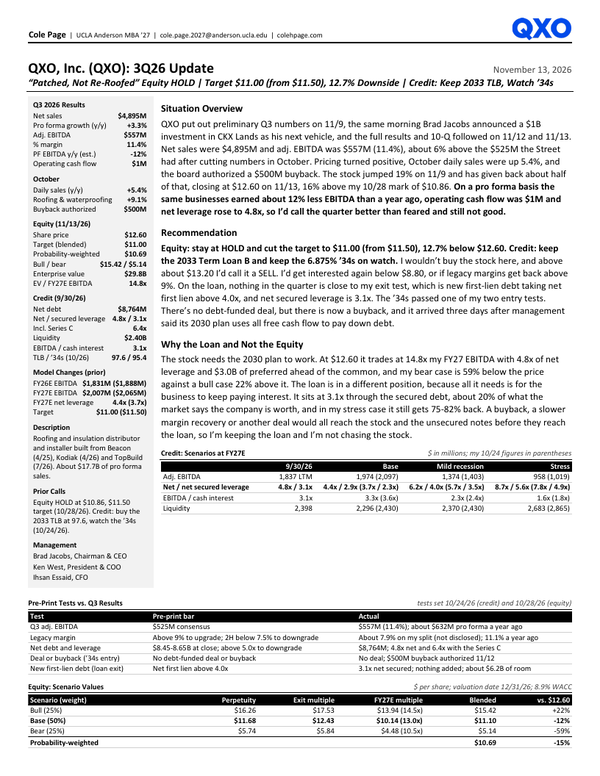
Q3 adj. EBITDA of $557M beat a lowered bar, but on a pro forma basis EBITDA fell about 12% and net leverage rose to 4.8x. The equity stays a HOLD with the target cut to $11.00, the term loan is still my pick, and a new $500M buyback keeps the 2034s on watch.
The Short Version
QXO put out preliminary Q3 numbers on 11/9, the same morning Brad Jacobs announced a $1B investment in CKX Lands as his next vehicle, and the full results and 10-Q followed on 11/12 and 11/13.
Net sales were $4,895M and adj. EBITDA was $557M (11.4%), about 6% above the $525M the Street had after cutting numbers in October. Pricing turned positive, October daily sales were up 5.4%, and the board authorized a $500M buyback. The stock jumped 19% on 11/9 and has given back about half of that, closing at $12.60 on 11/13, 16% above my 10/28 mark of $10.86. On a pro forma basis the same businesses earned about 12% less EBITDA than a year ago, operating cash flow was $1M and net leverage rose to 4.8x, so I'd call the quarter better than feared and still not good.
Equity: stay at HOLD and cut the target to $11.00 (from $11.50), 12.7% below $12.60. Credit: the 2033 Term Loan B is still my pick, and the 6.875% 2034s stay on watch. I wouldn't buy the equity here, and above about $13.20 I'd call it a SELL. I'd get interested again below $8.80, or if legacy margins get back above 9%. On the loan, nothing in the quarter is close to my exit test, which is new first-lien debt taking net first lien above 4.0x, and net secured leverage is 3.1x. The 2034s passed one of my two entry tests. There's no debt-funded deal, but there is now a buyback, and it arrived three days after management said its 2030 plan uses all free cash flow to pay down debt.
| Prior call | 11/13 | |
|---|---|---|
| Equity | HOLD at $10.86, $11.50 target (10/28) | HOLD at $12.60, $11.00 target |
| Credit | Buy the 2033 TLB at 97.6, watch the 2034s (10/24) | TLB still the pick; 2034s on watch |
| Upside to target | +5.9% | -12.7% |
| Bull / bear vs. price | +51% / -47% | +22% / -59% ($15.42 / $5.14) |
| EV / FY27E EBITDA | 14.8x | |
| Net / secured leverage | 4.6x / 3.0x (estimated at close) | 4.8x / 3.1x (6.4x with the Series C) |
| Liquidity | $2.40B | |
| EBITDA / cash interest | 3.1x | |
| TLB / 2034s | 97.6 / 95.4 (10/26) | No new marks |
Why the Loan and Not the Equity
The equity needs the 2030 plan to work. At $12.60 it trades at 14.8x my FY27 EBITDA with 4.8x of net leverage and $3.0B of preferred ahead of the common, and my bear case is 59% below the price against a bull case 22% above it. The loan is in a different position, because all it needs is for the business to keep paying interest. It sits at 3.1x through the secured debt, about 20% of what the market says the company is worth, and in my stress case it still gets 75-82% back. A buyback, a slower margin recovery or another deal would all reach the equity and the unsecured notes before they reach the loan, so I'd stay with the loan and not chase the equity.
Scoring the Tests
Before the print I wrote down what I'd need to see: the credit tests on 10/24 and the equity tests on 10/28.
| Test | Pre-print bar | Actual |
|---|---|---|
| Q3 adj. EBITDA | $525M consensus | $557M (11.4%); about $632M pro forma a year ago |
| Legacy margin | Above 9% to upgrade; 2H below 7.5% to downgrade | About 7.9% on my split (not disclosed); 11.1% a year ago |
| Net debt and leverage | $8.45-8.65B at close; above 5.0x to downgrade | $8,764M; 4.8x net and 6.4x with the Series C |
| Deal or buyback (2034s entry) | No debt-funded deal or buyback | No deal; $500M buyback authorized 11/12 |
| New first-lien debt (loan exit) | Net first lien above 4.0x | 3.1x net secured; nothing added; about $6.2B of room |
The Quarter
The headline says margin went up, from 11.1% to 11.4%. That compares a roofing distributor a year ago with a company that now gets a third of its sales from TopBuild, which earned 19.8% in last year's third quarter. Put the three businesses together in both periods and Q3 2025 was about $632M of EBITDA at 13.3%, so this quarter was down about 12% and the margin was about two points lower. You don't need my Kodiak estimate to see it. QXO's $301M and TopBuild's $275.6M add up to $577M a year ago before Kodiak earned anything, and all three earned $557M this year.
So why was the stock up 19%? Expectations were worse than that. RBC's checks in October pointed to a weak quarter, the Street had come down to $525M, and the manufacturers had a rough time. Owens Corning's roofing volumes fell 17% and it expects distributors to keep destocking in Q4. Against that, QXO's roofing sales fell 4.3% and legacy sales as a whole fell 2.4%, and price is the reason. Company-wide pricing went from -1.7% in April to +2.3% in September, and roofing and waterproofing went from -1.1% to +4.1%, in a quarter when Owens Corning called its own prices slightly higher. I give them credit for that, because it's the first hard evidence that the pricing tools Jacobs talks about do something.
What I can't tell you is which business the shortfall came from, because QXO reports one segment and won't recast until the 10-K. If TopBuild earned about 18% (Installed Building Products' margin fell about two points in the same quarter) and Kodiak about 8.5%, then the legacy roofing business earned about 7.9%, against 11.1% a year ago and 8.0% in Q2. Management says roofing gross margin rose year over year, so the gap has to be operating cost, and some of that is the people and systems they're adding on purpose. Kodiak's sales fell 4.8%, and TopBuild's 18% growth is mostly the acquisitions it made before QXO bought it. Mechanical insulation, which is the data center piece, grew 16%.
October looks strong, with daily sales up 5.4% and roofing and waterproofing up 9.1%, but last year's fourth quarter was down about 9%, so over two years roofing is roughly flat. Management also said organic daily revenue trends improved for a second straight quarter and didn't give the number. On my math legacy sales fell 9.9% in Q1, 1.6% in Q2 and 2.4% in Q3, so I don't see the second improvement in the business they've owned longest. It may be in the day count or in the acquired businesses.
The cash flow statement is the weak part. Operating cash flow was $1M in what should be a strong quarter, and that's with only $75M of interest paid against $163M expensed, because the new notes don't pay their first coupon until January. Payables and accrued expenses fell $239M. Some of that is spring inventory getting paid for, and Q4 is normally when a distributor's working capital comes back, so I'm not going to call it a problem off one quarter. After $57M of capex and $66M of preferred dividends, though, QXO burned about $120M. Stock compensation was $79M, up from $31M, which is why I don't lean on the $0.13 of adjusted EPS.
The Call and CKX
There was one call, on 11/9, and it covered the preliminary numbers and CKX together. Most of the questions were about the new company. Nobody asked about legacy margins, cash flow or leverage, and as far as I can tell there was no second call when the full results came out. That's part of why I can't cleanly separate the two pieces of news. What I can say is that QXO beat the homebuilder ETF by about 16 points on 11/9 and is still about 9 points ahead of it for the week, so most of what's left of the move is QXO's own. I'd put that on the quarter and on how low the bar was. I can't think of a way CKX adds a dollar of EBITDA to QXO.
CKX is the same structure Jacobs used to start QXO. Jacobs Private Equity puts in $900M and co-investors put in $100M for convertible preferred and warrants, he becomes chairman and CEO, and the company gets renamed and pointed at an industry he hasn't picked yet. It's expected to close in early 2027. He stays chairman and CEO of QXO, says he owns about a quarter of it, and told the call that leaving the XPO, GXO and RXO boards last year gave him the time.
I've been skeptical that this is good for QXO, and the obvious worry is his attention two years into a roll-up that just closed its biggest deal. There is one way it could help the debt. A founder building a second platform has less time and less reason to do another $15B deal here, and that kind of deal is what the unsecured notes can't defend against. I'd like that to be true, but I don't see the evidence yet. The same week, QXO moved its CFO, Ihsan Essaid, into a vice chairman job running M&A and capital raising, and hired his replacement from Novelis, which raised $8B through acquisition financings and refinancings while he was CFO. The 10-Q also says acquisitions paid for out of cash flow could add up to $1.5B of EBITDA by 2030, and on the call Jacobs said those would be done at single-digit multiples. Even at 6-8x that's $9-12B of deals in four years. My model has QXO generating about $3.3B after preferred dividends over that stretch, and even on management's own EBITDA path I only get to roughly $6B, so the arithmetic needs very cheap deals or more borrowing. So I think the deal machine is still staffed and still has a number attached to it, and CKX doesn't move my view of the credit in either direction.
The more useful thing on the call was the 2030 plan. Jacobs said QXO can take EBITDA from about $1.75B, which he described as current consensus, to $4.0B by 2030 without acquisitions, and that this case assumes all free cash flow goes to paying down debt. Three days later the board authorized a $500M buyback. Those two don't fit together, because if the cash goes to buybacks it isn't going to the term loan, and the buyback is the one the board voted on. He also didn't say what period the $1.75B covers. The three businesses earned about $1.84B over the last twelve months on my numbers, so either the Street has Q4 well below my $451M or he's using a different period than I am. My base case gets to about $2.8B in 2030, so I'm a long way short of his.
Equity: What I Changed
I put FY26 on three quarters of actuals plus my own Q4, which takes pro forma EBITDA to $1,831M from $1,888M, and I moved FY27 to $2,007M from $2,065M. Sales are a little higher than I had because of pricing, and margins are lower because the starting point is lower. I also raised stock compensation, which the old model had at 0.8% of sales against 1.6% in Q3. I left the multiples, the WACC method and the scenario weights alone, so the change in target comes from the cash flows, the 9/30 balance sheet and a slightly higher risk-free rate.
| Base case unless noted | 10/28 | 11/13 | Why |
|---|---|---|---|
| FY26E pro forma adj. EBITDA | $1,888M (10.7%) | $1,831M (10.3%) | Nine months of actuals plus Q4 at $451M; legacy margin about 6.3% for the year |
| FY27E net sales | $17,902M | $18,205M | Legacy +3% on price, TopBuild +2.5%, Kodiak flat |
| FY27E adj. EBITDA (base / bull / bear) | $2,065M / $2,287M / $1,744M | $2,007M / $2,194M / $1,690M | Legacy 7.0%, TopBuild 17.3%, Kodiak 7.8%; synergies still $60M |
| FY31E adj. EBITDA margin | 14.2% | 14.2% | Legacy still gets back to Beacon's 9.5%, from a lower start |
| Stock compensation (% of sales) | 0.8% | 1.4% in FY27E | $79M in Q3 and $147M over nine months; fades to 1.0% |
| Net debt | $8,450M | $8,764M | Debt $9,292M and cash $528M at 9/30 |
| WACC | 8.8% | 8.9% | 10-year Treasury 5.15% (5.05%); same method |
| Diluted shares | 1,497.6M | 1,500.1M | 1,039.96M common at 11/6; the buyback isn't counted |
Street FY27 EBITDA was $1,992M before the print, so I'm about where the Street was. KeyBanc cut its target to $19 from $28 and DA Davidson went to $19 from $20 after the results, and both still rate it a buy. Those targets are built on the 2030 plan, and I'm valuing the company on FY27 because I don't think a company at 4.8x gets valued on year four.
Equity: What the Price Needs
At $12.60 the diluted equity is worth $18.9B and the enterprise $29.8B. At the 13x I use on FY27 EBITDA, that needs about $2.29B of EBITDA, which is 14% above my base case and a little above my bull case. You can also get there on my base numbers at 14.8x. Each turn of the multiple is worth about $1.34 a share and each point of legacy margin about $0.83, so small changes in either one move the answer a lot. The base case comes out at $11.10 blended, which I round to an $11.00 target, and $10.69 probability-weighted, using the same methods and weights as before (25% perpetuity DCF, 25% exit-multiple DCF at 12x FY31E, 50% 13x FY27E).
| Scenario (weight) | Perpetuity | Exit multiple | FY27E multiple | Blended | vs. $12.60 |
|---|---|---|---|---|---|
| Bull (25%) | $16.26 | $17.53 | $13.94 (14.5x) | $15.42 | +22% |
| Base (50%) | $11.68 | $12.43 | $10.14 (13.0x) | $11.10 | -12% |
| Bear (25%) | $5.74 | $5.84 | $4.48 (10.5x) | $5.14 | -59% |
| Probability-weighted | $10.69 | -15% |
Valuation date 12/31/26; 8.9% WACC.
The risk/reward got worse as the price went up. In October the bull case was 51% above the stock and the bear case 47% below it. Now the bull case is 22% above and the bear case 59% below. On the adjusted regression beta, which gives a 10.1% WACC, the blended value drops to $10.00.
The peers moved as well. Builders FirstSource, Ferguson, Pool, SiteOne and Watsco are up 6-11% since my October memo, and on October estimates the median multiple of next year's EBITDA went from 14.1x to about 15.1x. QXO at 14.8x is now close to the group, with roughly twice the leverage (4.8x against a 2.3x median) and $3.0B of preferred ahead of the common. At the peer median my base FY27 EBITDA is worth about $12.90 a share, which is roughly where the stock is, so you can argue QXO is fairly priced against the group. I don't think it should trade with the group until its leverage is closer to theirs, so I'm keeping 13x.
Credit: What Changed
Leverage is higher than I had it. Net debt was $8,764M at 9/30 against the $8,654M I estimated at close, and LTM pro forma EBITDA is about $1,837M against $1,892M. That puts net leverage at 4.8x (4.6x), 3.1x through the secured debt (3.0x) and 6.4x counting the Series C. Liquidity is $2.40B, which is $528M of cash and $1.87B available on the ABL with nothing drawn, and nothing matures before 2030.
The buyback is the bigger change, because $500M is a little more than the $456M of free cash flow after preferred dividends I have for FY27, so if they use all of it next year the term loan doesn't get paid down and net leverage ends FY27 at 4.4x. In October I had 3.7x. About a quarter turn of that gap is the buyback, and the rest is lower EBITDA and the higher starting debt. The documents don't slow it down. The loan allows unlimited restricted payments while net first lien is at or below 3.55x, and it's about 2.6x on covenant EBITDA. The notes' ratio test isn't met, but their annual basket alone is about $1.0B. I wrote in October that every document allows a buyback, and this is the first time they've said they want one.
| $ in millions; 10/24 figures in parentheses | 9/30/26 | Base | Mild recession | Stress |
|---|---|---|---|---|
| Adj. EBITDA | 1,837 LTM | 1,974 (2,097) | 1,374 (1,403) | 958 (1,019) |
| Net / net secured leverage | 4.8x / 3.1x | 4.4x / 2.9x (3.7x / 2.3x) | 6.2x / 4.0x (5.7x / 3.5x) | 8.7x / 5.6x (7.8x / 4.9x) |
| EBITDA / cash interest | 3.1x | 3.3x (3.6x) | 2.3x (2.4x) | 1.6x (1.8x) |
| Liquidity | 2,398 | 2,296 (2,430) | 2,370 (2,430) | 2,683 (2,865) |
FY27E, no acquisitions; the base case uses the $500M buyback in FY27.
None of that changes what I think about the loan. I'd own it for the lien and the documents, and both are the same as they were. It sits at 3.1x and about 20% of enterprise value at today's stock price. Pari first-lien capacity is about $6.2B, so the 4.0x exit test is still a long way off, and at $1.3B of EBITDA or more the loan still recovers in full at 6.0x. The downside cases are a bit worse because they start from a lower margin. Mild recession takes net leverage to 6.2x with coverage at 2.3x, and stress takes it to 8.7x with coverage at 1.6x, which is close to the 1.5x where I said I'd stop holding through EBITDA-driven leverage. Recovery on the unsecured notes drops to about 41% from 44% at 6.5x on $1.5B of EBITDA, because payables are $1.74B now that TopBuild is in.
Credit: The 2034s
I said I'd buy the 2034s after the print if there was no debt-funded deal or buyback and legacy margins had stabilized. There's no deal, and margins look stable against Q2 on my estimate, although that's 7.9% against 11.1% a year ago and I can't check it until the 10-K. The buyback is what holds me back. It isn't debt-funded yet, but cash that buys stock doesn't pay down the loan ahead of the notes, and if management's priorities are moving toward shareholders the unsecured notes take the hit first. I'm also behind on price, since my last marks are from 10/26 (loan 97.6, 2034s 95.4). The stock is up about 20% since then and the 10-year Treasury is up about 15bp, so I'd expect the 2034s' spread to be tighter and the entry to be worse than when I set the test. I'm staying on watch, and I want to see Q4 cash flow and what they do with the buyback before I buy them.
What Would Change My Mind
For the equity it's the first pro forma outlook, which should come with Q4 results in February, and the recast segments in the 10-K, which will finally show legacy and TopBuild margins. For the debt it's Q4 cash flow and whether the buyback gets used.
| Signal | Now | Equity | Loan and 2034s |
|---|---|---|---|
| Share price | $12.60 against an $11.00 target | BUY below $8.80; SELL above $13.20 (20% either side) | |
| Legacy margin | About 7.9% in Q3 on my split; recast due in the 10-K | Above 9% is the BUY case; 2H below 7.5% is a downgrade | Review the loan below 7% two quarters running; 2034s wait for stable margins |
| FY27 outlook (February) | My base $2.0B; Street was $1.99B before the print | Above $2.3B moves me toward the bull case | |
| Q4 cash flow | Operating cash flow $1M in Q3 and -$145M year to date | Want working capital to come back in Q4 before buying the 2034s | |
| Buyback | $500M authorized 11/12; no expiry | Buying above $11 pays more than my value | Debt-funded: review the loan, no entry on the 2034s |
| New debt and M&A | 3.1x net secured; about $6.2B of pari room | New equity below $10 cuts the target | Exit the loan above 4.0x pro forma net first lien |
| Net leverage | 4.8x; 6.4x with the Series C | Above 5.0x on lower EBITDA is a downgrade | Hold the loan while coverage is above 1.5x and liquidity above $1.5B |
| Loan and bond prices | Last marks 10/26: 97.6 and 95.4 | Take profits on a repricing; buy the 2034s wider with no new debt |