Cole Page
Credit Analyst · cole.page.2027@anderson.ucla.edu · colehpage.com
XPO: Owning the First Lien Instead of the Notes
The 2031 first-lien term loan at par against the same issuer's unsecured notes at 104–105, where the call schedules capped total return.
The Call
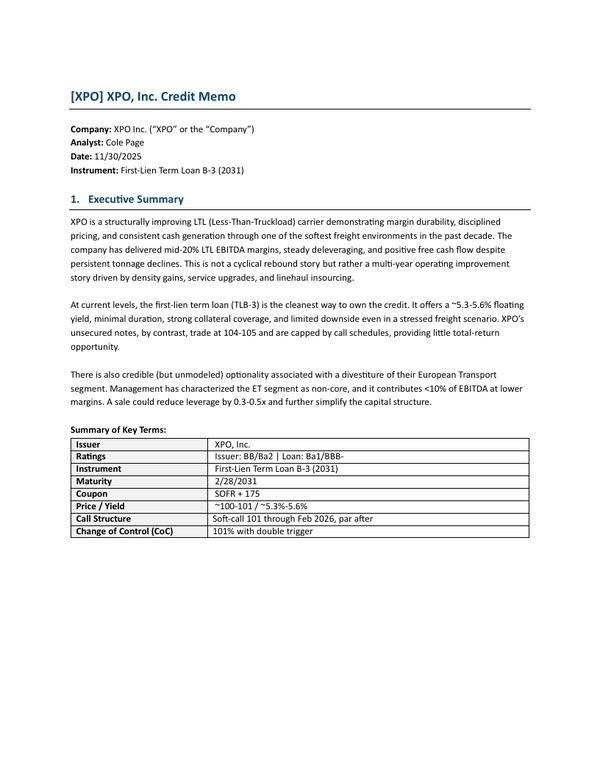
Buy the first-lien Term Loan B-3 due 2031 at ~100.4 for S+175 and a 5.39% yield to worst. Avoid the unsecured notes. Wait for the 2026–27 refinancing cycle to own unsecured paper, when there should be proper call protection and a new-issue concession to be paid for taking it.
XPO in November 2025 was a straightforward credit with a non-obvious tranche decision. The business was deleveraging on operating self-help through the weakest freight environment in a decade, the balance sheet was clean, and nothing matured before 2028. The yields alone did not identify the right place to own it.
Why the Loan and Not the Notes
| $mm | Maturity | Coupon | Price | Yield | Outstanding |
|---|---|---|---|---|---|
| Revolving Credit Agreement | 4/30/30 | S+75 | 0 | ||
| Senior Secured Term Loan B-2 | 5/24/28 | S+175 | 100.50 | 5.29% | 650 |
| Senior Secured Term Loan B-3 | 2/1/31 | S+175 | 100.38 | 5.39% | 400 |
| Senior Secured Notes | 6/1/28 | 6.250% | 102.07 | 4.79% | 830 |
| Total Secured | 1,880 | ||||
| Senior Notes | 6/1/31 | 7.125% | 104.37 | 5.21% | 450 |
| Senior Notes | 2/1/32 | 7.125% | 105.20 | 5.31% | 585 |
| Senior Debentures | 5/1/34 | 6.700% | 105.81 | 5.81% | 300 |
| Total Debt | 3,215 |
Net secured leverage 1.22x, net total leverage 2.28x, cash of $335mm against $1,263mm of LTM EBITDA, and $935mm of liquidity with the $600mm revolver fully undrawn.
The yield column read against the lien position gives the argument. The 2031 term loan yielded 5.39% from first position in the structure. The unsecured 2031 notes yielded 5.21% and the 2032s 5.31%, both below the loan, from behind $1.9B of secured claims. Buying either meant giving up seniority and yield at the same time. Only the 2034 debentures paid more than the loan, at 5.81%, which is compensation for holding to 2034 in a credit whose thesis is falling leverage.
The notes screened tight because they traded at 104–105 into their call schedules. Further tightening ran into the call price, so total return was capped by the document rather than by the credit. The loan had the opposite profile: floating rate, minimal duration, soft-call 101 rolling off in February 2026, and a near-par basis with a first lien on terminals, trailers, tractors and receivables.
What the Credit Rests On
Operating ratio is the primary profitability metric in LTL. Each 100bp of OR improvement translates directly into EBITDA margin and tends to persist across cycles.
XPO ran mid-82% in 3Q25, roughly 350bp better than two years prior, while LTL pounds per day fell 6.1% year over year and shipments per day fell 3.5%. Margin expansion during a volume decline indicates structural improvement rather than a cyclical rebound waiting to be given back. The supporting metrics point the same way: purchased transportation down 48% as linehaul moved in-house, claims ratio at 0.2% against 1.2% at the start of the program, eleven consecutive quarters of sequential yield ex-fuel growth, on-time performance up for fourteen consecutive quarters, and average tractor age down to 3.6 years, which indicates the $2.5B investment cycle is largely complete.
ODFL remains the benchmark in the low 70s. XPO had moved ahead of every non-union carrier except ODFL, and for a credit investor the direction and its source matter more than the absolute level.
Downside
The base case takes leverage to 1.7x in 2026, 1.4x by 2027 and 0.6x by 2030, on modest volume recovery and stable mid-20s LTL margins. Free cash flow above a $600mm minimum cash balance funds $150mm of annual buybacks, in line with the 2024 and 2025 run rate, and prepays the term loans with the remainder, TLB-2 first since it matures earliest and voluntary prepayments are borrower-directed. That leaves the $830mm of 2028 secured notes as the whole maturity wall, assumed refinanced at size and similar spreads rather than repaid. The loans are retired in 2029, after which the company holds more cash than secured debt, $1,118mm against $830mm.
The downside case assumes a 7% revenue decline, LTL margins compressing to 18.5–19.5%, and working capital usage of 5% of revenue in 2026. Leverage peaks at 3.5x in 2027 and improves after that. The case starts from $450mm of cash at year-end 2025 and spends it: free cash flow is negative for three years, at roughly -$320mm, -$138mm and -$26mm, cash reaches zero in 2027, and the revolver funds the gap, peaking at $34mm against a $600mm facility. Liquidity troughs at $566mm in 2028. A first-lien claim attaching at 1.2x is not impaired either way.
Five risks. Covenant flexibility, with capacity for roughly $2.6B of incremental first-lien debt under the credit agreement, enough to take first-lien net leverage from 1.2x to 3.3x. A deeper or longer freight trough. Execution risk on the margin program. The European segment as a lower-margin, FX-exposed drag pending a sale. The $1.5B secured maturity wall in mid-2028.
What This Memo Does Not Do
The recovery work stops at a single point estimate; there is no waterfall. The memo halves EBITDA, applies a 4.5x distressed multiple, and concludes that secured debt recovers in full. That is almost certainly the right answer at 1.2x attachment, but it is a stated conclusion rather than a built one. There is no going-concern case, no liquidation marks on the terminals, trailers, tractors and receivables the lien actually attaches to, and no sensitivity around the 4.5x.
The covenant section names the baskets without testing the definition underneath them. It has the $400mm free-and-clear basket and roughly $2.2B of ratio capacity against a 3.0x first-lien net leverage test at 1.2x, roughly $2.6B in all, and confirms that incremental debt would come pari passu rather than priming. What determines whether that $2.6B is real is the EBITDA definition and its add-backs, and those are not examined. Neither are the transfer restrictions that decide whether collateral can leave the credit group, which the memo asserts without citing the agreement.
The base case assumes no acquisitions for five years. That is a strong assumption about a company Brad Jacobs runs, it is the likeliest reason the deleveraging path does not happen, and it is not in the risk list.
A second pass would cover all three.
Independent work, written solo. Levels, metrics, and the refinancing view are as of 30-Nov-2025 and have not been refreshed.